Moisture Sensors and Building Envelope Monitoring for New England Homes
How smart moisture monitoring can help protect custom homes, additions and renovations from hidden water damage.
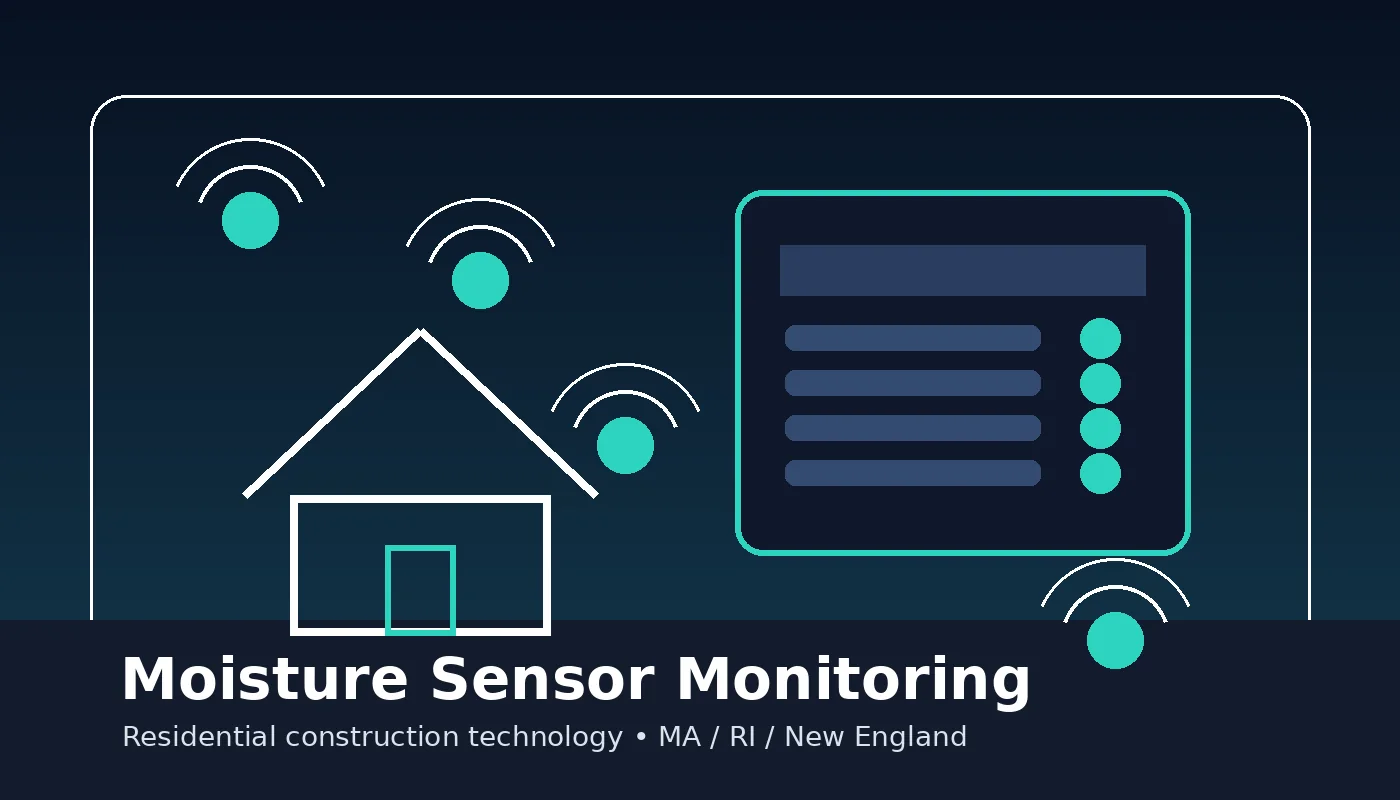
Moisture monitoring is moving from commercial buildings into homes
Water is one of the most expensive enemies of a New England home. Roof leaks, bulk water at foundations, condensation inside wall assemblies and slow plumbing failures can damage framing long before a stain appears on drywall. Moisture sensors and building envelope monitoring give homeowners and builders another layer of information after construction is complete. For custom homes, additions and major renovations, that can be a smart way to protect premium finishes and hard-to-access assemblies.
These systems range from simple leak sensors under appliances to embedded probes in roof assemblies, basement walls, crawl spaces or high-risk envelope transitions. The goal is not to fill a home with gadgets. The goal is to monitor areas where moisture risk is real and where early warning can prevent expensive repairs.
Where sensors make the most sense
The best locations are predictable risk points: under dishwashers and washing machines, near water heaters, around basement mechanical areas, in crawl spaces, below low-slope roof tie-ins, behind exterior cladding mockups, near deck ledger connections and inside areas with past leakage history. In additions, sensors can be useful where new construction meets an older building, because that joint often combines different framing depths, air sealing conditions and drainage details.
Coastal Rhode Island and Southeastern Massachusetts homes also deal with wind-driven rain, humid summers and freeze-thaw cycles. Monitoring does not eliminate the need for correct flashing, ventilation and drainage, but it can reveal when conditions are trending in the wrong direction.
How monitoring supports better building science
Moisture sensors are most useful when paired with good construction practices. A well-detailed wall still needs bulk water management, air sealing, vapor-aware material choices and drying potential. Sensors help confirm that the assembly is behaving as expected. If a monitored area stays dry through storms and seasonal changes, the team gains confidence. If readings rise, the response can happen before rot, mold or finish damage spreads.
For homeowners, the benefit is peace of mind. For builders, it is feedback. Construction teams rarely get long-term data on how an assembly performs after handoff. Monitoring can close that loop and support better decisions on future projects.
Questions to ask before adding sensors
Before installing sensors, decide what risk you are trying to manage, who will receive alerts, how batteries or power will be maintained, how data will be accessed, and what action should follow a warning. A sensor that nobody monitors is not a protection plan. It is clutter. The best systems are simple enough for the homeowner to understand and specific enough to guide a response.
Privacy and reliability matter too. Homeowners should know whether data stays local, uses a cloud service, or integrates with a broader smart home platform. Devices should be placed where they can be serviced and where readings will actually mean something.
A practical upgrade for high-value renovations
For a kitchen addition, finished basement, coastal renovation or custom home, moisture monitoring can be a modest investment compared with the cost of repairing concealed damage. It is especially valuable when paired with documented flashing details, photos before insulation, and a maintenance plan. Together, those records create a more resilient home.
Elarkx sees monitoring as part of a larger shift toward smarter construction: better planning, better documentation and better follow-up after the project is built. Technology is not a substitute for skilled work. It is a way to protect skilled work over time.
A practical homeowner checklist
If you are considering moisture monitoring, begin with the project’s real risk points. Ask which areas are most vulnerable, what the sensor will detect, who receives alerts, what maintenance is required and what steps should follow an alert. A useful monitoring plan should be understandable to the homeowner and specific to the home, not a generic smart-device package added at the end.
For renovations, ask the builder to combine sensor placement with photo documentation before insulation and finishes cover the work. Those records can be valuable years later when maintenance, warranty questions or future renovations come up. The strongest approach blends good flashing, sound building science, clear documentation and simple monitoring that remains useful after the contractor leaves.
The conversation should also include durability priorities. A finished basement, custom kitchen, low-slope roof connection or coastal wall assembly may justify more monitoring than a simple low-risk room. The right plan concentrates attention where water would be expensive, disruptive or difficult to discover early. That keeps the system cost sensible and the alerts meaningful.
Homeowners should ask how monitoring fits with maintenance. Gutters still need cleaning, caulk joints still need inspection, grading still matters and mechanical equipment still requires service. Sensors are an early-warning layer, not permission to ignore the basics. When expectations are clear, monitoring supports a more resilient home ownership experience.
What to expect after installation
After sensors are installed, homeowners should receive a simple map or list showing each device location, what it protects and what action to take if an alert occurs. The plan should distinguish between an urgent leak warning and a maintenance observation that deserves follow-up during normal business hours. Clear instructions prevent panic and make the system easier to live with.
It is also wise to review the system during seasonal maintenance. Batteries, connectivity and alert contacts may change over time. A quick review keeps the monitoring layer active and reinforces the larger purpose: protecting the investment made in the renovation or custom home. Like any construction technology, moisture monitoring works best when it is supported by good habits.
Planning a smarter project?
Elarkx Solution helps Massachusetts and Rhode Island homeowners plan custom homes, additions and renovations with practical field knowledge, clear scopes and modern construction documentation.
Schedule a project consultation